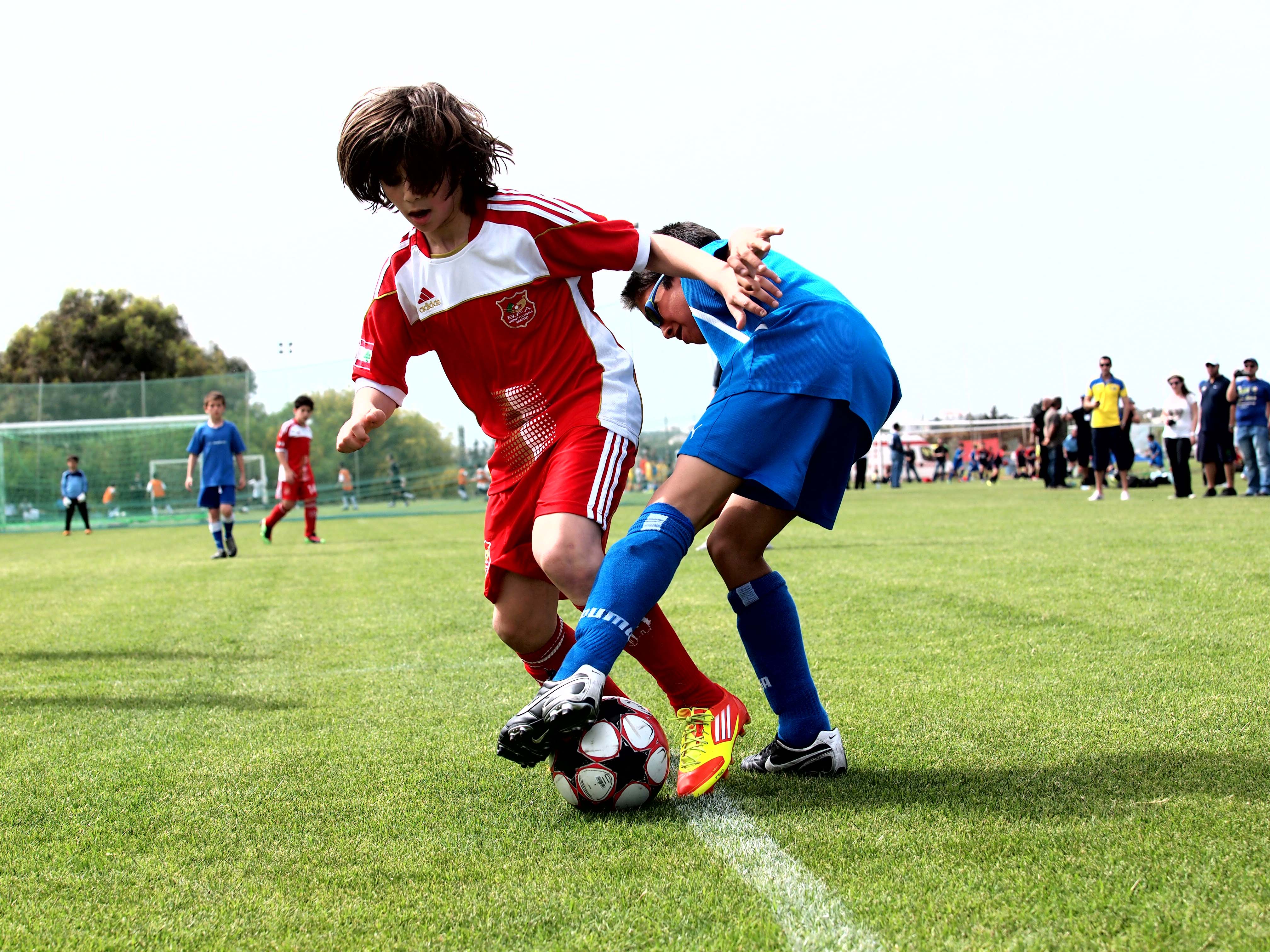
Cone knock off

Objective: To improve passing, movement off the ball and teamwork.

Age group: U7s to U12s.

Equipment required: Some flat cones, three balls, training vests in two colours.

Set-up:

  • Create a 25-yard square playing area.
  • Divide your players into a team of four (the attackers) and a team of two (the defenders).
  • If you have more than six players, vary the numbers in each team or (preferably) set up two playing areas.
  • Balance two balls on top of flat cones and place them in two corners of the playing area.

How to play:

  • The attacking team’s objective is to knock the two balls off the cones.
  • The defending team protects the balls by blocking shots, tackling and trying to gain possession of the ball.
  • Play for two minutes. If the attacking team succeeds in knocking both balls off, it earns a point.
  • If defenders can hold the attackers at bay for two minutes, they get a point.

Coaching points:

Attackers

  • Good movement off the ball.
  • Quick decisions.
  • Spreading out and using the whole playing area.

Defenders

  • Good communication.
  • Close down the attacker with the ball quickly but don’t dive in.
  • Don’t allow the attackers to split you with a pass.

Progressions/variations

1. Play 3v1.

2. A ball that is knocked off a cone is in play and can be used to knock the other ball off.

3. Add a third or fourth ball on a cone.

4. Make the playing area bigger or smaller.

For more soccer coaching tips and products visit Soccer Coach Weekly.

Exclusion zone

Age group: U6s to U12s.

Number of players: Ten.

Equipment required: Eight “traffic” cones, some flat cones to mark out the playing area, one ball, training vests to differentiate the teams.

Set-up: Create a playing area suitable for the age of your players. For U6s, I would use a 20×15 yards area. For U12s, a 40×30 yards area would be more suitable.

Mark a five-yard-wide exclusion zone at both ends of the playing area.

Place four traffic cones, spaced a few yards apart, in each exclusion zone.

Divide your players into two teams wearing different coloured vests.

How to play:

The object is to knock over the opponent’s cones with the ball.

The ball must be kept below head height.

Players must stay outside the exclusion zones, except to take a goal kick.

Players can only take as many touches on the ball as there are cones still standing in their opponent’s exclusion zone, i.e:

  • 4 cones standing – 4 touches
  • 3 cones standing – 3 touches
  • 2 cones standing – 2 touches
  • 1 cone standing – 1 touch (very difficult and only suitable for older players!)

If too many touches are taken, give a free kick to the other team. All free kicks are indirect.

If the ball goes out of play, start with a kick in from the side line, or a goal kick from inside the exclusion zone.

Play for 15 minutes or until one team knocks over all four opponent’s cones.

For more soccer coaching tips and products visit Soccer Coach Weekly.

The coconut game

Objective: This coaching game helps improve accuracy of passing and shooting.

Age range: U7s and upwards.

Difficulty: Medium.

Number of players: Whole team.

Equipment: A few flat cones, one ball

Set-up: Divide your players into two evenly matched teams.

Tip: Keep the teams small. If you have more than 10 players, make four teams and set up two games.

  • Create a 30×20-yard playing area.
  • Place five balls on top of cones on the goal line at both ends of the pitch.
  • Mark out a five-yard exclusion zone with flat cones at both ends of the pitch.

How to play

The objective for both teams is to knock all five of the opposition’s balls off their cones by shooting/passing a ball at them.

Players are not allowed to enter the five-yard exclusion zones in front of the balls.

The first team to knock all five balls off at one end is the winner.

Coaching points:

Emphasise good technique (“which is the more accurate – using the side of your foot or the laces?”), quick decision making (“if you hesitate, the chance is gone”) and making support runs off the ball.

For more soccer coaching tips and products visit Soccer Coaching Club.

Behind enemy lines

Objective: The object of this game is to improve passing/receiving skills.

Age range: U7s and upwards.

Difficulty: Medium.

Set-up: Create a 45×30-yard playing area divided into three 15-yard-wide zones.

Divide your players into three teams of four.

Note: If you have an odd number of players, it’s OK to have teams of three.

Place one team in each of the zones.

One ball per game.

How to play: The game begins with you giving the ball to a team in one of the end zones.

  • The players in that end zone pass it among themselves while looking for an opportunity to pass it through the team in the middle third to the team at the opposite end of the playing area.
  • If they succeed in passing the ball through the middle zone, they get a point and the team they passed to tries to pass it back.
  • If a pass from a team in one of the end zones is intercepted or kicked out of the playing area, it switches places with the team in the middle.
  • The first team to make five passes through the middle zone wins.

Coaching points:

Encourage players to play with their heads up, looking for an opportunity to get a pass in.

Congratulate players who make quick decisions.

Progression for older, more experienced players: Use a spare player as a defender who can move all over the playing area trying to steal the ball.

For more soccer coaching tips and products visit Soccer Coaching Club

Three way soccer

This game helps to improve your teams’ attacking, defending and goalkeeping skills.

Age range: U7s and upwards.

Difficulty: Easy.

Set-up: Divide your squad into teams of four or five plus one goalkeeper. It doesn’t matter if you have odd numbers, just make one or two teams bigger than the others.

Create a circular playing area about 30 yards across.

Make a three-sided goal in the middle of the playing area with three poles or cones placed about 6ft apart in a triangular formation.

How to play: Place one player in the triangular goal.

  • Two teams play football in the playing area.
  • They can score through any side of the triangular goal.
  • The waiting teams are spread around the edge of the playing area. They are allowed to stop the ball going out of play and can also receive passes from the players in the centre.
  • If an outside player receives a pass, she cannot be tackled and has to pass back to the team that passed to her.
  • Play “one goal, winner stays on” or for a set amount of time before switching the teams.

Progression: Add a target player who plays for the team in possession.

All attacks must include at least one pass to the target player.

For more soccer coaching tips and products visit Soccer Coaching Club.

Keep your eye on the ball

Objectives: to encourage your outfield players to play with their heads up and spot goal-scoring opportunities, and to encourage your goalkeepers to keep their eye on the ball and predict where the next attack is coming from.

Age range: U9 to U14

Set-up: play this game on a slightly narrower pitch than usual. For U10s, 40 yards long by 15 yards wide is ideal.

Place a small goal at each corner of the playing area.

Each team has one goalkeeper and between three and five outfield players.

How to play: Each team – and each goalkeeper – has two goals to defend.

First team to score X number of goals wins the game.

Alternatively, play for a set time.

Put a different player in goal every few minutes or after a goal is scored.

Progression:

  • Restrict outfield players to three touches.
  • Mark an exclusion zone about five yards in front of the goals where only the goalkeeper is allowed. This encourages your players to take their chances more positively and stops them trying to walk the ball into the net.
  • Set up several playing areas and play a mini tournament.

For more soccer coaching tips and products visit Soccer Coaching Club.