8 drills that improve shooting skills

Shooting drills

Shooting drillsPenalty Box Soccer

Objective: Practice scoring goals and marking in the penalty area.

Area: Penalty area (directly in front of the goal).

Players: Teams of three, two goalkeepers.

Equipment: Two sets of training bibs.

At least six soccer balls

Goal and two corner flags (or four corner flags for two goals)

Formation: Two teams of three are in the penalty area with a keeper defending each goal.

Procedure: The game starts with the keeper of the one team throwing the ball to a team-mate. The game is decided by the first goal scored. The team that scores stays on the field and the losing team is replaced by a new team.

To keep the game moving, keep plenty of balls in the goal and put a two-minute time limit on each game. If neither team scores in two minutes, both teams go off and two new teams restart the game.

Make sure to balance the teams.

The winner is the team with the most goals after 20 minutes.

Marbles

Players are organised into pairs, each with a ball. Standing with her back to the field of play, the first player throws her ball over her head. The second player then kicks her ball from the starting point and tries to hit the ball that was thrown. Play alternates by kicks until one ball is hit. The players then change over and start again. Coaches should emphasise instep kicks for length and the side of the foot for accuracy. Make it a condition that every other game is left foot only.
Four Goal Game (heads up!)

Set up four 2 cone goals in each corner of a 20 yd x 30 yd grid. Divide players into two equal teams. Players may score at any of the four goals. This is an excellent game for encouraging teamwork; getting heads up and discouraging bunching round the ball.

Shoot Between Cones

Set up a line of cones row 3 to 5 yards apart. Pair up players and put one player on each side of the line facing the cones and each other. Players should start close to the row of cones at first, striking the ball between the cones. The partner receives ball and passes it back through the cones. Move players further apart as their technique and accuracy improve

Go For Goal

Players form two lines on either side of the coach who is standing 18 to 20 yards from a goal that is any size. The coach serves the ball toward the goal line while one player races to win the ball and shoot. As skills improve, add a goalkeeper. The coach should encourage correct shooting technique and a good first touch on the ball.
Dribble Cones and Shoot

Set up two cone lines for a dribble weave about 30 yards with a 2 yard goal at the end. Divide players into two lines or teams. Players must dribble through the cones and score at the goal at the end before the next player in line starts.
Pass and Strike

Set up a 30 yd x 30 yd grid with two opposing goals. Divide players into two equal teams. Each team must make four complete passes before they can shoot on goal. If the ball is taken by the opponent the team must start its pass count again.

Hit the Cone

Set up cones in a line, with three feet between each cone. Line up two players on opposing sides of each cone, facing one another. Give one of the opposing players a ball. The object of the game is to knock down the cone in as few shots as possible. When the first shooter misses the cone, their partner should trap the ball and take a shot. When the cone is knocked over, one player should set it back up and continue playing. For a variation, play the game for one minute intervals, and encourage the players to improve their record each time.

Pass and Shoot

Set up two cones as a goal at one end of the grid and divide the team in half. Pick one player to start as goalie. Then line one group up behind the goal, with one ball for each player. Line the other group up fifteen feet in front of the goal, in the centre. The first player in line should pass the ball to the first player in the centre line. This person then traps the ball and takes a shot on goal. After their turns, the players should get in the end of the alternate line (players who took shots need to retrieve the ball if needed). Switch goalies often. For large groups, two games can be set up at opposite ends of the grid. Later, have the shooting line take their shots with only one touch.

Quick Shot

Divide players into groups of three, and give each group one ball and two cones. Set the cones up as a goal, and have one player be the goalie. The remaining two players should be on opposite sides of the goal, facing each other. They take turns shooting on goal. When the goalie makes a save, he should turn and roll the ball to the other player. Switch goalies often.

Divide the team into pairs. Give each pair one ball and four cones. Set the cones up as two separate goals, about 10 yards apart. Every player stands in front of a goal and takes turns shooting and being the goalie. Initially, have the players shoot a stationary ball. Then have them stand behind their goal line and dribble up to it before shooting or have the goalie roll the ball to the shooter for a one-touch shot

Cone Kick Down

This is played just like a regular small sided game, but instead of having a goal to shoot at set up five cones along each goal line. The first team to knock down all five cones wins. There are no goalies.

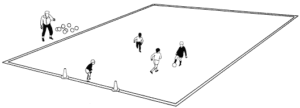
1v1v1

1v1v1

1v1v1Game Rules

One ball for three players in the area shown in the diagram, approximately 15 yards square.

Each player plays against the other two players.

Each player tries to score in a goal four to five yards wide.

When the ball goes out of play, the coach puts another ball in play.

Goalkeeper making a save throws the ball to the coach.

After 10 balls are served, all three players and the goalkeeper are changed.

Keep score and play the winners against each other to name the champion.

Player Objectives

Control the ball from the coach.

Manipulate the ball to avoid challenges.

Shield the ball when necessary.

Change direction – turn with the ball.

Change pace.

Shoot at the earliest opportunity.

Inside, outside

This is an effective pre-match soccer warm-up, as well as a good way to improve ball skills in training sessions for players of all ages.

Objective:

To improve passing and receiving skills.

Skill level:

Beginners and upwards.

Number of players:

The whole squad.

Set up:

Create a circular playing area at least 20 yards in diameter. The bigger the area, the harder your players will have to work. Smaller areas will require more skill.

How to play:

Half the players are equally spaced around the edge of the circle with a ball. The other half work inside the circle. On your command, the players in the circle run to a player on the outside, receive a pass and pass back.

Players then run quickly to another player on the outside and repeat.

Play for a minute and then swap roles. Give each team two or three turns as an inside and outside player.

Coaching points:

  • Ask your players to work at pace. They should turn and run quickly.
  • As the inside players approach an outside player, they should call for the ball, loudly.
  • The players on the outside of the circle need to stay on their toes and not let return passes go past them.

Variations:

  • Outside players can hold the ball in their hands and serve it at varying heights and speeds.
  • The players on the inside have a ball each. They dribble to an outside player, pass to them, get a return pass and dribble at speed to another outside player. Repeat.

Growth spurts

Growth sprts

Growth sprtsGrowth spurts can be a big issue for some children.

They have a disorientating affect on their sporting activities and make them more susceptible to injury.

When do they strike?

Girls tend to have growth spurts between the ages of seven and 12, while boys typically experience growth spurts later – usually from 10 to 14, but every child is unique and develops at a different rate.

What’s happening?

During a growth spurt a child’s bones grow first and fast and their muscles and tendons become inflexible as they get stretched tight until they catch up.

The child’s longer limbs, bigger feet and lack of muscular structure can often lead to a loss in co-ordination.

And there’s a greater tendency to be injury-prone.

Useful precautions

  • Make sure your child stretches before and AFTER sport (it’s a better stretch and improves flexibility quickly)
  • Ease your child into new seasons or sports
  • Keep ability levels as closely matched as possible
  • Avoid explosive sports!

Where injuries hit

In particular watch out for nagging heel or knee injuries and inflammations.

Late developers

Some kids may be at a disadvantage physically if they are late maturers.

But keep up the words of encouragement.

Late developers can still go on to have excellent sporting experiences.

Regular trips to the shoe shop and trousers that rapidly become too short are common occurrences during puberty.

In their teens, children put on an amazing growth spurt to reach their final adult height. At their fastest, boys can grow taller by as much as 9cm a year and girls at a rate of 8cm a year. It’s no wonder teenagers are clumsy. Their body is shooting upwards at a speed their brain simply cannot keep up with.

Outside-in

This phenomenal growth starts at the outside of the body and works in. Hands and feet are the first to expand. Needing new shoes is the first sign of trouble.
teenagers shoot up so fast that their brains can’t keep up

Next, arms and legs grow longer, and even here the ‘outside-in’ rule applies. The shin bones lengthen before the thigh, and the forearm before the upper arm.

Finally the spine grows. The very last expansion is a broadening of the chest and shoulders in boys, and a widening of the hips and pelvis in girls.

Growing up and tripping over

Many teenagers shoot up so fast that their brains cannot keep up. As their height increases, their centre of gravity lifts. This happens so quickly that the brain does not get a chance to calculate the new rules for balancing. Clumsiness is often unavoidable.

The trigger

Rapidly increasing height is a sign that a teenager is experiencing puberty. Growth is triggered in both boys and girls by increased levels of the sex hormone testosterone. This chemical also triggers the sexual organs to develop. In fact, the relationship between growth of the skeleton and puberty is so strong that a teenager’s developmental age can be measured by looking at the maturity of the bones in their hand and wrist.

Perfect timing?

Timing is everything. No teenager wants to be developing too quickly, or lagging behind. In reality, many of them grow up much earlier or later than the average and this is perfectly normal.

The average boy is growing fastest between 14 and 15. Girls start earlier, growing fastest when 12 and 13. Girls also end their growth spurt earlier at 18, while boys need another two years before they finish growing aged 20.

Frosty pitch inspections

Frosty soccer pitch

Youth soccer coaches have to be careful not to allow matches to go ahead on unsuitable pitches.

There can often be pressure to allow the game to go ahead from your own team (who are usually keen to play no matter what the conditions) and the opposition (who may have travelled a considerable distance). However, this must be resisted. The health and safety of the players has to come first.

The article below was written by an experienced referee and offers some advice for coaches who are about to inspect a hard, frosty pitch.


Frosty soccer pitchThere is no scientific measure that can be used to deem a frosty ice covered field to be safe.

Nevertheless, any experienced Referee will take the following into consideration before making a decision.

It is the Referee’s responsibility to make the decision and nobody else’s.

The whole of the field of play surface MUST be safe. There is a great danger that if 99 percent of the field of play surface is OK, and the game is allowed to be played, players will assume that 100 percent is OK, and play normally, and not compensate for any hard surface areas. In other words, playing on a hard field of play, which is partially 99% OK, is just as dangerous (if not more so) than on a field of play, which is totally hard. Neither game should be played.

The Referee should not be influenced by the teams’ opinion. If an accident happens, it is the Referee who cops it.

The teams will deny any responsibility! Therefore, when a field of play inspection is carried out, the Referee should not do so in company of team managers or Club Officials, as they will try to influence the Referee’s decision.

When the weather is doubtful, the Referee should aim to arrive at the ground as early as he can to make an inspection. This may allow time for travelling teams to be warned of a cancellation.

When the weather is doubtful, a check on the local weather forecast can help. For example, although a field of play may be frozen in the early hours of the morning, a prediction of sunshine, will give the Referee a good idea of the possibility that the field may become playable later in the day. If the forecast is for snow or frost or freezing temperatures, then the chances are, that the game will not proceed.

At lower level football, it can be useful for a local Referee to be contacted, to make an early inspection on behalf of the match Referee who lives some distance away from the ground. This can prevent unnecessary travelling.

When completing the field of play inspection, a good indicator of the suitability of the surface, can be ascertained by inspecting the goalmouth areas and the centre circle area first. These are the areas that get more use, and are more likely to be rutted and hard due to frost.

When completing the field of play inspection, other areas for close inspection, are places covered in shadow from buildings or trees. They are more likely to be frost bound, rather than those areas basked in sunshine.

When completing the field of play inspection, if it is not immediately clear that the game cannot be played (i.e. the goalmouth areas are completely solid with frost and the game is definitely cancelled), the whole of the field of play surface MUST must be inspected to eliminate any hidden areas of danger.

A referee, who is seen to be completing a thorough field of play inspection, will have greater credibility when he decides to call off the game, than a Referee who only spends a few minutes making his inspection.

The position of the sun and its path as the game progresses must also be taken into consideration. For example, if a field of play is ‘just about playable’, but the path of the sun means that its rays will disappear behind the trees or over the horizon, then the field of play surface on a cold frosty day, will get worse, not better.

At local level, if it is clear, that waiting an extra 30 minutes or possibly up to an hour, will allow the sun to melt the frost, then play could be delayed with the agreement of both teams. But this depends very much on the weather forecast, the time of day and the team’s agreement. Generally, it is better to make a decision quickly, based on the surface suitability at the time of the scheduled kick-off.

The referee should wear a set of studded boots when inspecting the field of play, as this will give the best indication of the suitability of the playing surface.

A surface which does not yield any purchase to studded boots, is dangerous, and the game should not be sanctioned. This includes, any part of the surface that does not yield, no matter how small an area.

A field of play with hard deep frosted ruts and divots (a legacy of a muddy game played the day before) is less likely to be playable than a completely flat field with only crusty surface-frost to contend with.

When the Referee has made his decision, it should be communicated to the teams as soon as possible. When a Referee is communicating his decision to the teams, that in his opinion, the field of play is not safe, the decision should be made confidently. If teams suspect any doubt in the Referee’s decision, they will try and persuade the Referee to change his mind. In short, when a Referee makes his decision, he should not back down, and he should make it abundantly clear that the decision is his to make, and the game will not be played under his authority.

The inspection of a field of play covered in frost, and whether to sanction a game or not, is not a difficult decision to make for a Referee. It is fairly obvious to identify dangerous area that could potentially cause an injury. Common sense should be used.

Young players are more likely to get injured on hard surfaces. Therefore, even greater care must be taken when making a decision to allow the game to be played or not.

If there is any doubt (no matter how small), then the game must not be played.

First aid advice

When you accept the role of coach, you accept a major responsibility for the care and safety of your players. Although your children must share in the responsibility for their protection and safety, their ability to understand what they can do, how they can do it, and whether they are doing it correctly, may be limited. It is your job to help them practice and play as safely as possible.

The information below is not meant as a substitute for a first aid course. If you don’t already have first aid certification, I encourage you to enrol in both CPR and first aid classes so that you can handle any accidents that may happen while you are coaching.

Your job as a volunteer coach is to recognise an injury when it happens, to stabilise the injury as best you can, and to summon medical assistance if necessary. You must understand the limitations of your training and knowledge. If you are not a trained medical professional:

Play it safe. Call the emergency services if you are not sure what to do.

Have a plan

It is important to have a well thought out plan for dealing with injuries and a written response plan for emergencies. Keep this in your coaching bag where you can pull it out and refer to it if necessary. Some points to consider in your plan are:

  • Is a first aid kit available?
  • Do I have all of my players’ medical consent forms and emergency contacts with me at all times?
  • Where is the nearest phone
  • How do I get first aid and/or paramedics/ambulance?
  • Do any of my assistant coaches or parent volunteers know first aid?
  • Who will go for help if I need to attend to an injured player?
  • Who will supervise other players if I need to summon help?
  • Do my assistant coaches and players know the emergency plan?

Injury Prevention

An ounce of prevention is worth a pound of cure. Prevent injuries in every way possible. Some important steps that can help you in your injury prevention plan include the following:

Emphasise proper skill development,

Inspect practice and game fields (e.g. look for holes, sprinkler heads, etc.).

Hopefully you won’t have many injuries (kids are amazing resilient!) but if you do you should know how to recognise and treat common soccer injuries.

Child protection for youth soccer coaches

It’s a sad fact that many children are abused sexually, emotionally or physically.

As a soccer coach you are in a unique position to spot any signs of abuse among your children. It is vital, therefore, that you are able to recognise the signs of abuse and know what to do if you suspect anything untoward.

You also have a responsibility not to abuse the children in your care by bullying or criticising them in front of their peers. You must also make sure that you do not expose your children to extremes of weather, leave your children unsupervised, tell them to ‘get on with it!’ when they have been injured or train them in an over intense or in a way inappropriate to their age.

All these are forms of child abuse.

You should find that most clubs have a Child Protection Officer (CPO) whose job it is to brief the club coaches about their responsibilities in this area. But if you are either working on your own or within a club that has no CPO you’ll have to teach yourself about this important and sensitive subject.

Please read the following carefully and always bear it in mind.

Sexual abuse

Both boys and girls can be sexually abused. Abuse can include: full sexual intercourse, masturbation, oral sex, fondling showing children pornographic books or videos or taking pornographic photographs or videos.

Physical abuse

Children can be physically abused by hitting, shaking, squeezing, biting or burning. In soccer, as with all sports, physical abuse may occur when the nature and intensity or training exceeds the capacity of the child’s body.

Physical abuse can also occur when adults fail to meet a child’s basic physical needs. e.g. food, warmth and clothing.

Neglect in soccer might occur if a coach fails to ensure her children are safe or exposes them to extreme weather conditions or potential injury.

Examples of emotional abuse

  • Persistent lack of love or affection.
  • Children frequently being shouted at or being taunted,
  • Over protection leading to poor social skills.
  • Failure to give children love, affection or attention.
  • Leaving children alone and unsupervised.
  • Emotional abuse in soccer may include situations where parents or coaches subject children to constant criticism, bullying or unrealistic pressure to perform to high expectations.

Visible signs of child emotional/physical abuse

  • Fear of parents being contacted, going home or receiving medical advice,
  • Flinching when touched,
  • Refusal to discuss injury,
  • Covering arms and legs,
  • Over reaction to mistakes,
  • Sudden speech disorders,
  • Extremes of emotions,
  • Self mutilation,
  • Unexplained or untreated Injuries,
  • Injuries on unlikely or unusual parts of the body,
  • Cigarette burns, bite, belt marks, or scalds,
  • Poor personal hygiene,
  • Constantly hungry & tired,
  • Inappropriate clothing or dress,
  • Dishevelled appearance,
  • Lonely, no friends,
  • Obviously underweight,
  • No parental support or interest
  • Visible signs of sexual abuse
  • Pain, itching, bruising, or bleeding in the genital area
  • Stomach pains.
  • Discomfort when walking
  • Unexplained sources of money
  • Inappropriate sexual drawings / language / behaviour,
  • Being withdrawn or in fear of one person

If a child tells you something that suggests they are being abused you must understand that this may be the only time the child has built up courage to tell someone what has happened.

Stop what you are doing and respect the child’s privacy. Stay calm and reassuring. Listen to what they tell you. Tell them that whatever the circumstances they are not to blame. Do not react in a way which may add to the child’s distress, e.g. anger or shock. Explain that you cannot promise to keep what the child tells you a secret as you may have to tell someone else.

Do not question the child in depth and do not ask leading questions. i.e. questions that need a “yes” or “no” answer. Only ask questions to establish exactly what was done and who did it.

Tell the child that you are pleased they decided to tell someone and that they are absolutely right to do so. Let the child know that you understand how difficult it is to talk about such experiences.

Inform the Team Manager (unless implicated).

Do not contact parents until you have received advice. Make an accurate record of the time and date and exactly what was said.

Sometimes there may not be any signs of abuse; you may just feel that something is wrong. If you even slightly worried it is your responsibility to act on your concerns and do something about it.

If you suspect a child has been abused you must contact your Local Authority Child Protection Officer or the Police without delay.

IF A CHILD DISCLOSES ABUSE

It is the duty of all League Management, Referees, Club Officials, Team Managers and any other individuals directly or indirectly involved with member clubs or teams playing in leagues to be aware of and help prevent child abuse.

The children’s welfare is paramount and all children, whatever age, culture, disability, gender or religious belief, have the right to protection from abuse.

All suspicions and allegations of abuse should be taken seriously and responded to swiftly and appropriately.

You MUST:

  • Treat all players and children with respect and dignity befitting of their age,
  • Watch your language, tone of voice and where you put your body.

You must NOT:

  • Engage in rough, physical or sexually provocative games including horseplay
  • Allow or engage in inappropriate or intrusive touching of any kind
  • Allow children to use inappropriate language unchallenged
  • Make sexually suggestive comments to a child even in fun
  • Let allegations a child make go unchallenged or unrecorded
  • Invade the privacy of children when they are changing, showering or going to the toilet
  • Doing things of a personal nature that children can do for themselves. e.g. help with changing.
  • Spend excessive amounts of time alone with children away from others.
  • Take children alone on car journeys, however short.
  • Take children to your home.