Bowling with Headers

Bowling with headers

A fun soccer heading game

Setup: Depending upon the number of kids divide them into equal groups of 5-7 players per group. All players in each group form a single file line except for one player who is the server. The server uses three standard “flat style” training cones and places them in a row about 10 feet in front of the first player in the single file line. The three cones are perpendicular to the single file line and each cone is about 18″ apart. The server places a football on top of each cone.

Bowling with headers

How to play: Each server stands behind his line of three (ball topped) cones and tosses the ball underhanded to the first person in the line. The first person in the line tries to head the ball down and knock a ball or balls off the cones. It’s possible but unlikely for one header to knock all three balls off the cones by knocking one ball into the other balls. The person who just headed the ball goes to the end of the line. The server collects the ball and gets back into position behind the row of cones and serves the ball to the next player in line.

This is a competition between teams/groups. Last group to knock all three balls off their cones loses and must perform a fun/functional task – running, push-ups, etc.

Blob Tag

blobtagAll the players are inside the grid. All but three have a soccer ball at their feet. The three without a ball form a ‘blob’ by holding hands. The blob moves freely in the grid and tries to kick any player’s ball out of the grid. If a player’s ball leaves the grid he/she joins the blob.

Once a chain has six or more players, have it break apart into two smaller chains (of three people each). The last player dribbling is the winner.

COACHING POINTS

“Stay away from the blob”– that’s the purpose of the game.

“Don’t get trapped” — move into space away from the blob.

“Keep control of the ball” — don’t kick it too far away.

“Work together” — the blob must work as a team. They must stay together when kicking balls out of the grid.

VARIATIONS

Change the size of the grid. Bigger grid makes it easier for dribblers.

Have blobs break into two players per blob. (Harder for dribblers).

Six simple SSGs

These SSGs are designed to improve passing, dribbling and shooting skills

4 v. 4 The Basic Game

pill026

Size of Field

Depends on the age of players. Can vary from 30 yd. x 20 yd. up to 40 yd. x 25 yd.. The goals are 8 feet wide.

The Team In Possession of the Ball

  • Can employ build-up by using the entire playing area in terms of length and width (spread out, possession).
  • Can learn and determine team shape, which, in a group of 4 resembles a diamond.
  • Can create goal scoring opportunities by taking action either individually or collectively.
  • When the Other Team Has the Ball

  • The aim is to prevent goals from being scored by getting behind the ball and to regain possession of the ball.
  • Simple principles of defending are reinforced and amplified since there is no spare defender or goalkeeper.
  • Variations of the 4 v. 4 Game

    Using slightly different sizes of goals, differing methods to score, and slightly altered size and shape of field can guide players to solve problems by emphasizing certain aspects of play.

    4 v. 4 Line Soccer

    pill027

  • Each team has a line to defend and attack.
  • Score a goal by dribbling the ball over any portion of the line that your team is attacking.
  • The size of the field is the same as a standard 4 v. 4 game, but it is turned sideways. The wider, shorter field allows for maintaining good shape (diamond), but also creates many good 1 v. 1 situations which challenges the player’s dribbling skills.
  • Players need to evaluate and identify when to dribble and pass. This variation highlights: The correct attitude (when to take a risk aggressively) and the technical development and execution of dribbling.
  • 4 v. 4 The Dribbling Game

    pill028

    The Game

    Same field as the “Line Soccer” game, a wide, short field. teams can score in one of 2 ways. Passing into an open goal or by stopping the ball on the endline between the two goals they are attacking.

    What The Game Incorporates

  • Vision
  • Changes in the direction and speed of play due to the shape of the field and presence of multiple goals.
  • Decision making skills because the player has a variety of options at his disposal (dribbling, passing, “shooting”, changing directions)
  • 4 v. 4 The Passing Game

    pill029

    The Game

    Since the playing area is longer than it is wide, the emphasis is on creating length (height) in the game. In this game, there is a premium placed on playing the ball forward early. The ball can be played early:

  • To a target player who is coming back for the ball with a defender behind them (as shown in diagram).
  • To a player running forward away from the server.
  • Scoring

  • Stopping the ball anywhere on the line.
  • Passing the ball through an open goal.
  • This Game Emphasizes

  • Vision
  • Changes in direction and speed of play.
  • Appropriate use of firm touch.
  • Long and short passing.
  • Transitions

    pill030

    The Game

    While one team attacks the large goal, the opposition attacks either of the two smaller goals. When the team scores in one of the two smaller goals, they must change directions and take a turn at attacking the larger goal.

    This Game Emphasizes

  • Attitude and confidence that is essential for scoring goals. (Large net)
  • Passing, shooting and dribbling skills required in the other 4 v. 4 games.
  • Transition awareness since the team can attack quickly in the other direction.
  • Team shape and the roles of each player because when there is a transition, the back becomes the front and vice versa.
  • 4 v. 4 The Shooting Game

    pill031

    The priority of this game is shooting and scoring. Since the field is wide and short, players should be looking to shoot almost whenever they get the ball. Game played like a regular 4 v. 4 match.

    Black Hole Keepaway

    Black Hole Keepaway

    Black Hole Keepaway

    Focus: Possession through passing, spreading out, using space.

    Age: U8-U10 (And older)

    Equipment: Flat cones to define the playing area. Coloured bibs to identify teams. A couple of balls.

    Players: 12-16 players work well, as few as 10 will work in a pinch, and as many as 20 can be accommodated.

    Space: 30×30 to 40×40 or so. Can be done easily on half a field.

    Introduction: Getting young players to recognize the usefulness of spreading out can be one of the most challenging aspects of coaching youth soccer. The plaintive cry of “Spread Out!” can be heard from the sidelines in many youth matches. This exercise should help the young players discover the value of spreading out and passing to maintain possession, in a fun and intuitive way.

    Setup: Establish area boundaries compatible with the age and number of players present. Four U10’s start with an area about 30 yards in diameter and define it with flat cones. Inside the area, create another, smaller circle about 7-10 yards in diameter. This is the “Black Hole”. For older players like U12, make the area larger, like 40 yards in diameter, and the black hole proportionally larger, like 10-15 yards in diameter. I even use this with U14’s with the centre circle (20 yards in diameter) as the “Black Hole”.

    Split the team evenly, and identify the teams with different colored pinnies. In the following diagram, the z team has possession of the ball, and the x team is defending/trying to get possession.

    Big goals, small goals

    This is a good game for improving communication skills among your players. The players attacking the two small goals have to work together to score in an unguarded goal.

    The team attacking the large goal has two goals to defend with just four players. Talking to each other is required!

    Skill level: intermediate

    Set up: place two small goals at one end of a 30 yards by 40 yards area and a full-size goal at the other end.

    Divide your squad into teams of four and five.

    How to play: the team with five players has a goalkeeper and four outfield players. This team attacks the two small goals. The team of four attacks the large goal.

    Coaching points: encourage good, loud communication between the players.

    The team of five should be trying to switch play from one side of the playing area to the other quickly while the team of four (attacking the large goal) need to think about what to do if they lose the ball. For example, should two players be assigned to protect each goal?

    Bend it like Beckham!

    We’ve all seen players such as Beckham, Ronaldo and Zidane bend the ball round a wall and into the net from free kicks taken anything up to thirty yards away from goal.

    We’d all like to have a player who can do that on our team!

    So how can we teach our players to ‘bend it like Beckham’?

    It’s a matter of using the right technique and lots of practice.

    The technique (for a right footed player):

    Approach the ball from the left at a slight angle. If you run straight at the ball you can’t strike it correctly.

    As you run up, keep your eyes fixed on the base of the ball.

    Strike the ball on the right side of the base with the inside of your right foot and hit across it from the inside to the outside.

    This will generate a right-to-left swerve.

    The non kicking foot should be planted on the left of the ball and slightly behind it. The further back the non kicking foot, the higher the ball will go.

    Keep your head still and don’t look away from the ball until you strike it.

    Now it’s time to practise

    To do this, use a full size goal with a keeper and line up your players about twenty yards from the goal. Your players can now practise swerving the ball around a wall (that’s you or a willing parent:) into the goal.

    Watch their technique and correct as required.

    Bending the ball is a skill that requires hours of practice. Encourage your players to work on it at home and show you how good they have become at the next coaching session.

    Basic futsal coaching

    How to coach youth futsal

    I. The basics

    The priority in Futsal is to motivate players in an environment that is conducive to learning. The more pleasure kids derive from their participation, the more they wish to play and practice on their own. While their instinct to play is natural, their affection and appreciation for soccer must be cultivated. Futsal is the foundation to such goals because it:

    • Allows players to frequently touch the one “toy” on the field, namely, the ball.
    • Presents many opportunities to score goals and score goals often.
    • Encourages regaining possession of the ball as a productive, fun and rewarding part of the game (defending).
    • Maximizes active participation and minimizes inactivity and boredom.
    • Provides a well organized playing environment with improvised fields.
    • Reflects the philosophy of player development expressed in state and national coaching schools.
    • Eliminates complicated rules such as off-sides that may hinder youngsters from “playing”.
    • Reflects the appropriate roll of the coach as a Facilitator
    • Makes the game more “beginning coach” friendly because the game is simpler, thus making it easier to recruit more volunteer “coaches”.
    • Allows the game to be the teacher!

    What About The Goalkeeper?

    Goalkeeping, as it relates to the adult version of soccer, requires a combination of skill, athleticism, and decision making. A Futsal goalkeeper learns all these things in the game of Futsal with the added advantage that he learns to react faster because the ball moves faster, and he gets more involvement in the game since they are more shots on goal. Nevertheless a:

    Goalkeepers must be field players first. Prior to specializing as goalkeepers, children must learn the broader parameters of “play”. This is difficult to do when they hide beneath the crossbar. Goalkeepers must also learn intuition and anticipation from moving in and playing the game of Futsal.

    Goalkeepers must possess field playing skill. This is particularly true since the laws governing the 11 v. 11 game require the goalkeeper to play as a field player, without the use of their hands, at certain times of the game.

    II. Why Futsal?

    The mode and method for children’s play has changed substantially. The sandlot and playgrounds which allowed for free play have been replaced by organized sport associations and leagues which are instead governed by adults. As a result, these leagues reflect what adults believe the game of soccer should be like for youngsters. The by-product of this is often overcoaching and the investing of an abundance of money and resources on uniforms. warm-ups, and equipment. There is always the likelihood that parents and coaches become too involved in the game during “the game”.

    Teaching Futsal to children requires that the information provided to them is appropriate for their maturity level through some means (THE GAME) that makes sense to them. The environment for play must, essentially, meet the needs of players.

    Reducing the number of players to 5 per team allows for all of the components that are present in the 11 v. 11 game: the ball, teammates and opponents, realistic pressure, appropriate space, guidelines (rules), direction of play (attacking and defending), and the combination of length and width in the game (team shape), and shooting on goal.

    What Is Developed

    Skill that is realistic. Motor ability: balance, agility, and coordination. Perception: insight and awareness. Vision. Problem solving: choices and decisions. Physical fitness. Psychological domain: fun, enjoyment, and competition. Learning by discovery, trial and error, playing!!!

    Repetition

    This is perhaps the single most important aspect over the long term process of developing soccer playing ability. On the playgrounds and sandlots, this occurs naturally… No lines, no waiting, participation is maximized.

    Youngsters recognize differing situations that are constantly repeated. Repetition influences: Skill required to play the game (dribbling, passing, shooting, etc.). Decisions and choices that occur during the game.

    III. The Role of the Youth Coach

    In Futsal, the role of the coach is that of facilitator. The coach sets up the game and the conditions for learning, provides some supervision and allows the game to teach. The coach becomes a manager of the games with the comprehensive and long range objective being to develop and improve the soccer performance of the players.

    The primary objective for youth players under 11 years of age is the development of technical skill. This is due, in part, to the nature of youngsters and their willingness to experiment to find their own way to execute technical skill.

    Another contributing factor for am emphasis on skill development is that skill is considered a shortcoming. Remember, technique is not an objective in and of itself but a tool. Technical skill must always have a relationship with the game (application). Problem solving, decision making, intuition, anticipation, and technical skill must be developed in the context of games.

    Technical activities, outside of games, should not be considered the “end all and be all”. The game, and involvement of playing the game, is most important. Too often, these activities on the individual basis are “drills” and are not realistic as far as the demands of the game are concerned. Technical skills should not be viewed as “tricks” or “gimmicks”, but in the end, must be practical to use in the game.

    Basic ball skill games

    Red Light, Green Light

    The games described below can easily be incorporated into practice sessions for young children. They’re fun, simple to explain and help reinforce basic skills without any pressure.
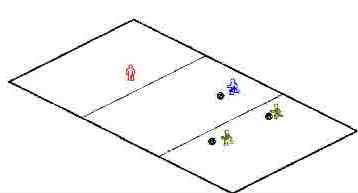
    Red Light, Green LightRed Light – Green Light

    For the very young Under 6 the game of Red Light – Green Light is an easy game to learn and teaches the children to keep the ball close and under control.

    THE GAME

    Each player has a ball, except the one player that is designated as the “light”.

    Lines from start to finish should be approximately 20 – 30 yards.

    Players start from the line opposite the “light”.

    The “light” then turns away from the group shouting out “GREEN LIGHT”.

    At this signal, the players start to dribble towards the “light”.

    When the “light” turns round, calling “RED LIGHT”, players must freeze and stop their ball.

    If the “light” catches players or a ball still moving that player must take 5 steps back.

    The first player to cross the line where the “light” is standing is the winner and becomes the new “light”.

    You can start the game without using balls for younger players, then have them roll the ball with their hands, then use their feet.

    North –South – East and West

    Players dribble where the coach tells them to, i.e. a direction as suggested in the title or you can make it a colour or an animal, whatever. This again teaches the children to keep the ball close and , hopefully, shows them how to change a direction.

    Draw

    This is a very popular game with the younger crowd. Place players in 2 lines facing each other. Place one football in the middle of the each two players .

    The object of the game is to draw the ball back using the sole of the foot. The command to “Draw” is given by the coach. The fun part is that the coach has to tell a story in which he uses the word “draw” to signal the players.

    For example: Willy and his sister were working on cleaning their rooms. Willy

    said “where should I put these socks? And his sister replied , “In your Drawer.” Make up really silly stories.

    You can add progression to this drill by having the players jog in place, have the players only use the non-dominant foot, have the players move up a ladder if they win and down if they lose the round and see who can get to the top first.

    “GET EM”

    Here is a game which involves both passing and dribbling that is fun and engages players quickly. Also, although primarily an individual exercise that allows for differences in ability level, if the players are ready, it can quickly become a cooperative game where players work together to solve a challenge.

    The Game

    • Each player will need a ball. Player ‘A’ is “It” and is the only player to start with a ball. All the other players around the outside of the grided space.
    • Player ‘A’ dribbles and tries to hit the other players below the waist with the ball.
    • When hit, that player gets a ball and joins player ‘A’.
    • The game is over when all of the players have been caught.
    • The last player caught is “It” and starts with the ball for the next game.

    If you think the task will be too difficult for the one player to get another at the

    start of the game, start with 2 players being “It”.

    Coaching Points of Get-Em

    • Encourage quick movements and sudden changes of direction to catch players off guard.
    • Players not caught should run, jump, and use zig-zag movements.

    A variation can be added by having all players play with a ball

    RUNNING BASES

    Here is another game that emphasizes dribbling that is fun and challenging for players. Again, primarily it is an individual game that could lend itself to small group cooperation if the players are ready.

    The Game

    Each player will need a ball, except those that have been designated as “It”. Players that are “It” need to carry a coloured bib or flag in their hand. Players with a ball try to dribble without being tagged. If they are, they exchange places with the “tagger” (The “tagger” hands the bib to the dribbler and takes their ball).

    Dribblers are safe in one of the designated bases. Only one player is allowed in a base at a time. if a new player enters a base, the old player must leave the base.

    Add “taggers” when the players find the game to be easy.

    It seems about right to have one base for every 3 players, but, this number can be adjusted either way to make the game constantly interesting.

    This game can also be played by only allowing the “tagger” to “get” someone by kicking their ball away, not just “tagging” the person. (a variation on Shark)

    Experiment with different combinations of “taggers” and bases to keep the players engaged.

    Basic Passing Game U7: Trick or Treat

    This is a drill suggested by Ivan Mann, a coaching colleague from the soccercoach- l mailing list.

    Set Up and Execution

    Make a square with pretty small sides – players line up on each side. Put an adult in the middle of each side (that means four adults) holding a dozen or so flat cones (you could use anything else similar size and shape). 50 cones or 50 slips of construction paper will do.

    On a go signal, players dribble across the square, stop the ball with a foot on it, say “Trick or Treat”, take a cone from an adult, turn the ball, dribble back across, take a cone, etc. When all the cones are gone, who has the most? This requires dribbling at speed, avoiding the clump in the middle, controlling the ball around an opponent, but minimal coordination holding the cones.

    After a few rounds dribble across the square, dribble around the coach, and then stop the ball, say “Trick or treat,” etc. Or place the adults randomly in the square, moving at a walking pace. This makes them keep their heads up and look for the target (i.e. the adult).